

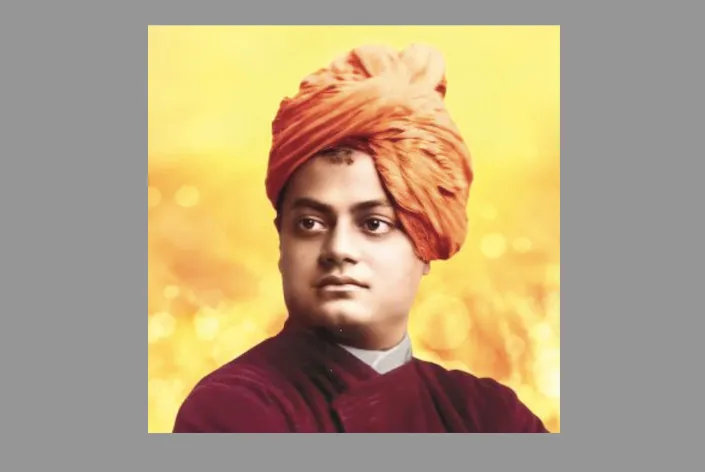
Swami Vivekananda stands as one of the most luminous figures in modern Indian history—a monk, philosopher, patriot, and visionary who reinterpreted India’s ancient spiritual wisdom for a modern, global audience. Born as Narendranath Datta on January 12, 1863, in Calcutta, Vivekananda emerged at a critical moment when India was grappling with colonial domination, social stagnation, and a crisis of self-confidence. His life and message became a clarion call for spiritual awakening, social reform, and national regeneration.
From an early age, Narendranath displayed a questioning mind and an intense yearning for truth. Educated in Western philosophy, logic, and science, he was deeply influenced by rationalist thought, yet remained restless in his search for spiritual certainty. This inner conflict found resolution when he met Sri Ramakrishna Paramahamsa, the mystic saint of Dakshineswar. Under Ramakrishna’s guidance, Vivekananda experienced a profound spiritual transformation. He came to realize that the essence of all religions lies in the same ultimate truth, a conviction that would later shape his universalist outlook.
After Ramakrishna’s passing in 1886, Vivekananda embraced the life of a wandering monk. Traveling extensively across India, he witnessed firsthand the pervasive poverty, ignorance, and social inequalities afflicting the masses. These experiences deeply affected him. He recognized that India’s spiritual greatness had to be complemented by material upliftment and social justice. For Vivekananda, spirituality divorced from service was hollow. This realization crystallized into his famous doctrine: “Service to man is service to God.”
Vivekananda’s global fame was sealed at the World’s Parliament of Religions in Chicago in 1893. His opening address, beginning with the words “Sisters and Brothers of America,” elicited a standing ovation and instant admiration. In his speeches, he presented Vedanta as a rational, tolerant, and universal philosophy, emphasizing harmony among religions rather than conflict. At a time when the West often viewed Eastern traditions with skepticism or condescension, Vivekananda asserted India’s intellectual and spiritual heritage with dignity and confidence. He became, in effect, India’s foremost spiritual ambassador to the world.
Beyond religious philosophy, Vivekananda was deeply concerned with nation-building. He believed that the regeneration of India depended on the strength of its youth. His exhortations—“Arise, awake, and stop not till the goal is reached”—continue to inspire generations. He called for man-making education, one that builds character, self-reliance, and a spirit of service, rather than mere accumulation of information. To him, education was the means to awaken the dormant potential within every individual.
In 1897, Vivekananda founded the Ramakrishna Mission, institutionalizing his ideal of practical Vedanta. The Mission combined spiritual practice with social service, engaging in education, healthcare, disaster relief, and rural development. Its enduring relevance lies in its synthesis of contemplation and action, reflecting Vivekananda’s conviction that true spirituality expresses itself through selfless work for the welfare of humanity.
Swami Vivekananda’s influence extended far beyond his lifetime, which was tragically short—he passed away on July 4, 1902, at the age of 39. Yet, his ideas played a crucial role in shaping modern Indian thought. Leaders of the freedom movement, including Mahatma Gandhi, Subhas Chandra Bose, and Jawaharlal Nehru, acknowledged his impact. He infused India with a renewed sense of pride and purpose, urging Indians to overcome fatalism and rediscover their inherent strength.
At the core of Vivekananda’s philosophy was an unshakeable faith in the divinity of the human soul. He taught that every individual possesses infinite potential and that realization of this truth is the highest goal of life. His message transcended narrow religious boundaries, advocating universal brotherhood, social equality, and respect for all cultures.
In an age marked by material excess, moral uncertainty, and social fragmentation, Swami Vivekananda’s teachings remain profoundly relevant. His call for harmony between science and spirituality, individual excellence and social responsibility, continues to offer guidance. More than a historical figure, Vivekananda endures as a living force—urging humanity to be fearless, compassionate, and ever-striving toward truth.
Swami Vivekananda’s association with Kashmir occupies a distinctive place in his life and spiritual journey. His visits to the Valley were not merely travels to a picturesque land, but deeply reflective encounters with India’s spiritual past, living traditions, and civilizational challenges. Kashmir, long celebrated as Sharada Desh—a historic seat of learning and spirituality—held a special significance for Vivekananda, who saw in it both the glory and the tragedy of India’s cultural history.
Vivekananda visited Kashmir during his travels in 1897–1898, after his triumphant return from the West. By then, he was no longer an obscure wandering monk but a global figure, carrying the burden of India’s spiritual message and the pain of her social decline. Kashmir, with its ancient temples, sacred lakes, and intellectual legacy, deeply moved him. He regarded it as a land where Vedantic thought, Shaivism, and learning had once flourished at the highest level.
One of the most emotionally intense episodes of Vivekananda’s Kashmir visit was his association with the Kheer Bhawani temple, dedicated to Goddess Ragnya Devi, a revered shrine of the Kashmiri Pandits. Situated near Tullamulla, the temple is centered around a sacred spring whose changing colors are traditionally believed to hold spiritual significance. Vivekananda visited Kheer Bhawani during a period of inner turmoil and spiritual struggle. According to accounts, he was deeply disturbed by the historical suffering of Kashmir’s people and the desecration and neglect of its ancient temples.
At Kheer Bhawani, Vivekananda is believed to have entered a state of intense prayer and emotional surrender. Overcome with anguish, he is said to have wept before the Goddess, questioning why such a spiritually elevated land had been subjected to centuries of decline, invasion, and human suffering. In that moment of despair, tradition holds that he experienced an inner spiritual assurance—a voice or intuition—that consoled him and urged him to let go of anger and judgment. The message, as recalled later, was one of acceptance: history unfolds according to larger cosmic laws, and spiritual renewal must arise through compassion, not resentment.
This episode marked a significant transformation in Vivekananda’s outlook. Until then, he had often expressed sharp anguish and even anger over India’s historical subjugation. After Kheer Bhawani, there was a noticeable softening in his tone. He increasingly emphasized inner strength, self-purification, and constructive service rather than blame or bitterness. Kashmir, in this sense, became a crucible for his evolving philosophy of national regeneration rooted in spiritual resilience.
Vivekananda’s time in Kashmir also reflected his deep concern for education and cultural revival. He lamented the loss of Kashmir’s ancient intellectual traditions, particularly the decline of centers of learning associated with Sanskrit scholarship and philosophy. He believed that reclaiming India’s future required reconnecting with such knowledge systems while simultaneously empowering the masses through modern education and social reform.
Another remarkable episode from his Kashmir stay was his attempt to visit the ancient Sharada Peeth temple, once a renowned center of learning comparable to Nalanda. Though political and logistical barriers prevented him from reaching the site, the very desire symbolized his reverence for India’s lost centers of wisdom and his anguish over their neglect.
Swami Vivekananda’s visits to Kashmir and Kheer Bhawani were thus far more than geographic journeys. They were deeply spiritual encounters that shaped his inner life and public mission. Kashmir embodied for him both India’s civilizational brilliance and its historical wounds. His experience at Kheer Bhawani, in particular, reinforced his belief that India’s redemption would come not through anger or nostalgia, but through spiritual awakening, compassion, and selfless service. Today, his Kashmir reflections remain a poignant reminder of the enduring bond between spirituality, culture, and national consciousness.


