

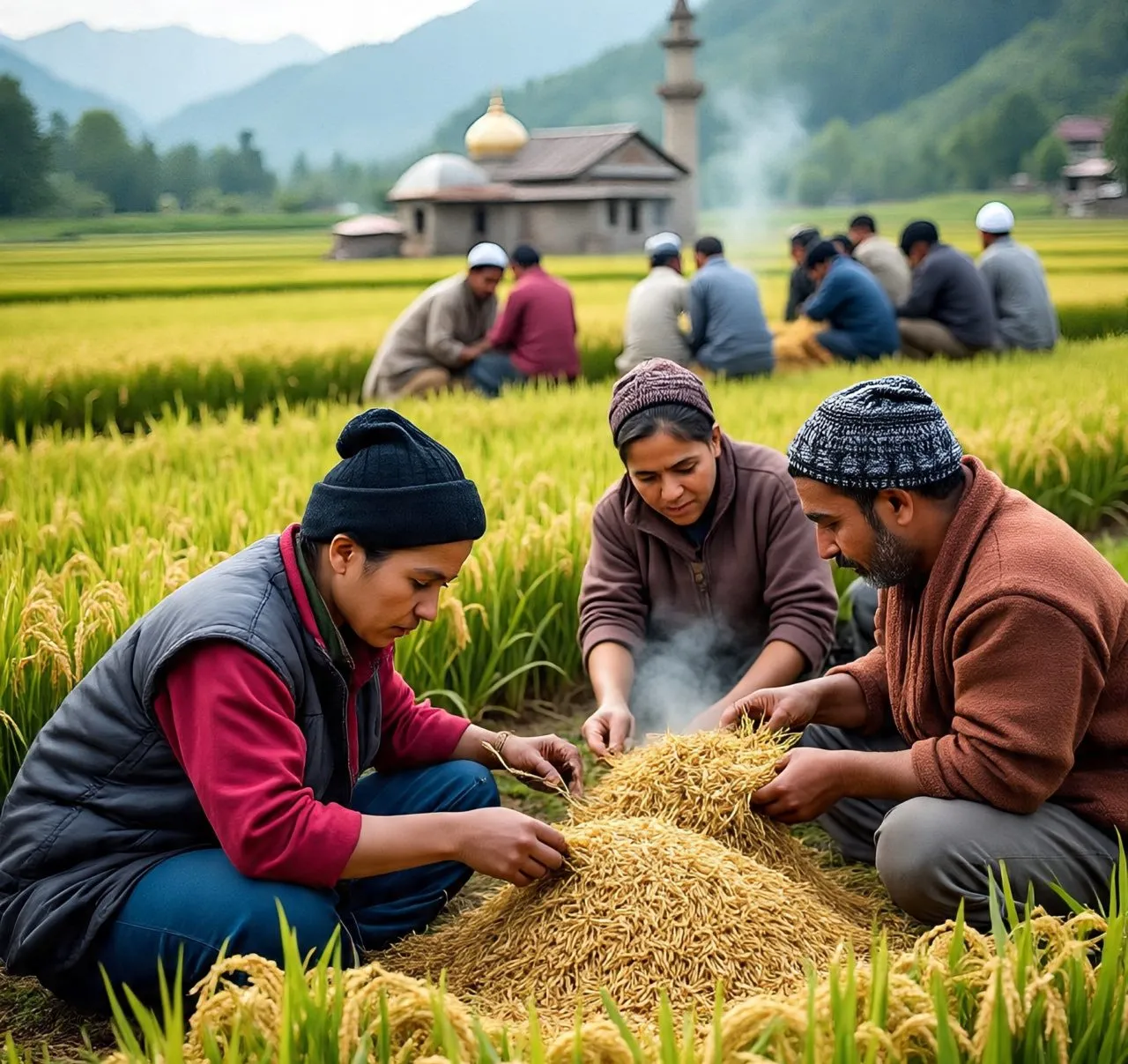
Talking about the social history of Kashmir, it is frequently articulated through the perspective of conquest and resistance. In the era of mid-eighteenth and mid-nineteenth century, during the Afghan (1752–1819) and Sikh (1819–1846) dominions, the valley had a complex paradoxical social structure characterized by both exploitation and cooperation. These two regimes instituted one of the most severe economic systems in Kashmir’s history, exhausting its resources, suppressing its people, and shattering its economy. Despite oppression, Kashmiris constructed a moral and community economy, a cooperative model that anticipated the socialist consciousness of the contemporary period.
The Afghan Regime
The acquisition of Kashmir by Ahmad Shah Abdali in 1752 signified the onset of a violent period in the valley’s history. The Afghan Durranis controlled by military governors who perceived Kashmir not as a province to administer, but as a tributary estate to exploit (Bamzai, 1994). Their principal objective was revenue generation, rather than governance.
Breaking barriers, the Taxation went beyond land earnings to include trees, livestock, fruits, and cooking utensils. According to Tareekh-i-Kashmir and some Persian chronicles, Afghan officials forced payments in kind, frequently surpassing 50 % of the overall yield. The most notorious among them, Azad Khan, Haji Karim Dad Khan, and Amir Khan Jawansher, transformed income collecting into an act of harassment. Villagers sought refuge in forest areas, discarding their properties to evade the cruelty of tax collectors (Chhabra, 2005).
The Muslim agrarian peasantry predominantly suffered under the Afghan fiscal regimen. The authorities did not invest in irrigation as well as in agricultural productivity. Officials operated as private profiteers, amassing wealth through extortion (Bamzai, 1994). The urban elite linked to Kabul thrived, while the rural parts deteriorated into ruins.
This pattern of collective endurance amid exploitation may be described as a primitive socialism not ideologically articulated, but materially practiced. It was the socialism of necessity: peasants pooling labour, sharing resources, and surviving through mutual dependence when the state withdrew from moral responsibility.
The Sikh Rule
In 1819, the Sikh army of Maharaja Ranjit Singh, under Misr Diwan Chand, expelled the Afghans from Kashmir. The event was greeted with joy, Afghans were remembered as tormentors, and the arrival of the Khalsa army as liberation. But that joy proved short-lived.
Within a few years, the same pattern of economic extraction resumed, this time cloaked in administrative order. Under Sikh governors such as Moti Ram, Diwan Kirpa Ram, and later Gulab Singh, Kashmir was transformed into a centrally managed revenue estate (Banga, 1978). Taxes were meticulously recorded, revenue assessments were standardized, and military supervision replaced arbitrary violence. Yet the position of peasantry remained unchanged dispossessed, overburdened, and voiceless.
British travellers like Alexander Cunningham (1871) and William Moorcroft (1841) recorded that Kashmiri cultivators were left with only one-sixth of their produce after taxation. Land revenue, import duties, and forced labour known locally as begar consumed both time as well as livelihood. Peasants were compelled to carry timber and supplies for state projects without any pay. (Moorcroft, 1841).
The Sikh regime thus bureaucratized Afghan brutality. Exploitation became systemic, predictable, and inescapable. The people of Kashmir moved from one mode of oppression to another from the violence of soldiers to the discipline of record-keepers (Cunningham, 1871).
The Shawl Weavers
While the Afghan rule devastated the countryside, the Sikh era turned its gaze toward the city, particularly the shawl-weaving industry of Srinagar. For centuries, Kashmir’s shawls had adorned the courts of Persia and France, symbolizing refinement and labour excellence. Under the Sikhs, this industry became the fiscal backbone of the state and its most exploited sector.
Thousands of shawl-bafs (weavers), mostly Muslims, worked in cramped cellars, weaving for state-licensed merchants known as kar-khanedars. The government taxed every loom and extracted duties from exported shawls. According to Bamzai (1994), the state’s revenue from the shawl trade often surpassed that from agriculture.
The shawl workers were forbidden from changing employers or selling directly to traders. Wages were fixed, and punishments for defiance were severe. British travellers described the weaver’s quarters as “underground prisons of labour” (Moorcroft, 1841).
Nevertheless, even amidst these coercive workshops, solidarity emerged. Weavers collected funds for burial purposes, marriages, and other unforeseen emergencies; they shared looms and resources; and in times of distress or natural calamities, they supported one another through common kitchens. These collective practices reflected an early class consciousness an embryonic sense of shared exploitation and shared destiny.
In many ways, the shawl-bafs were the valley’s first proletariat, their existence foreshadowing the organized labour movements of the twentieth century (Rai, 2004).
Sufi and Rishi Traditions
Throughout both the Afghan and Sikh regimes, Sufi and Rishi institutions offered moral and social resistance to oppression. Shrines such as those of Sheikh Nooruddin Noorani (Nund Rishi), Hazratbal, and Makhdoom Sahib functioned as parallel welfare systems, redistributing food and shelter through langar (community kitchens).
In a society marked by taxation and caste based hierarchies, the shrines were spaces of equality. Both peasants and artisans shared meals, prayed together, and found dignity in a moral order outside the state. The Rishi-Sufi ethos of Kashmir promoted a worldview of simplicity, labour, and collective compassion values that resonated with the later socialist ideal of communal welfare (Rai, 2004).
As Indu Banga (1978) observes, Kashmir’s rural institutions retained “forms of community cooperation that defied feudal hierarchy.” These forms. collective farming, ritual exchange, and food-sharing became the valley’s social infrastructure of resistance.
This tradition of moral economy, sustained through religion, made sure that despite political repression, the people’s sense of social equality survived. In this sense, the socialism of Kashmir was born not in factories or the manifestos but in shrines and fields in the everyday ethics of coexistence.
Religion, Labor, and the Seeds of Resistance
Religion under Afghan and Sikh rule was often instrumentalized for political legitimacy – the Afghans invoking Islam, the Sikhs invoking Khalsa sovereignty. Yet among the common people, religion became a language of dissent.
The folk verses of Kashmiri and Sufi poetry reflected hunger, inequality, and divine justice. Poets and preachers used metaphors of divine unity (tawheed) to critique worldly tyranny (Rai, 2004). Faith and labour merged into a moral opposition, demand for dignity within a divinely equal creation.
This union of spirituality and material struggle formed the emotional foundation of what would later become the socialist political culture of Kashmir. The valley’s socialism thus carried a spiritual texture rooted in compassion and labour, not ideology alone.
Continuity into the Modern Age
When the Dogra dynasty took control of Kashmir in 1846, under the Treaty of Amritsar, the system of extraction persisted with new masters. Peasants remained bound to the land; artisans continued to work in poverty. Yet, centuries of endurance under Afghan and Sikh oppression had already shaped a collective consciousness of justice.
This consciousness resurfaced in the early twentieth century, culminating in the Naya Kashmir Manifesto (1944) under Sheikh Abdullah. The manifesto’s emphasis on land redistribution, education, and workers’ rights reflected not just imported socialist ideals but a continuation of Kashmir’s historical experience the ethics of cooperation born from centuries of shared suffering (Bamzai, 1994).
As historian Mridu Rai (2004) aptly argues, the Kashmiri demand for equality “did not emerge in a vacuum of colonial modernity but from the moral economy of its pre-modern past.” The Afghan and Sikh rules thus served as the crucible in which this moral economy was forged.
Conclusion
The Afghan and Sikh regimes in Kashmir represent two successive modes of domination: one military and the other bureaucratic. Both extracted wealth without reinvestment, both eroded local autonomy, and both treated the valley as a fiscal appendage. Yet paradoxically, through these very systems of exploitation, the Kashmiri people forged the foundations of collective resilience, social equality, and moral solidarity.
The socialism of Kashmir did not begin with political ideology it began with survival. It lived in the shared grain of peasants, the joint looms of weavers, and the open kitchens of shrines. It was the socialism of faith and necessity a people’s socialism, rooted in endurance rather than revolution.
Today, when the valley’s political memory is often fragmented between narratives of faith and nationalism, remembering this socialistic past restores a missing chapter: the story of how Kashmir’s people learned to live collectively in the face of oppression, transforming suffering into solidarity.
Younus Yousuf Ganie, Research Scholar, Department of History and Culture, Jamia Millia Islamia, New Delhi


