

Despite the widespread use of Solar Gregorian Calendar World over for timekeeping, the ancient civilizations like the Chinese, the Hindus, the Arabs and the Jews, many other as well, continue to use Lunar Calendars for religious purposes. The start of a lunar month is different in different civilizations. It is either heralded on the day of the occurrence of Lunar Conjunction or on the day next to it or on the day which follows the evening on which a young new crescent is sighted with naked eyes. The Lunar Conjunction is an event whereunder the moon-face facing earth does not receive any sunlight and becomes momentarily a dark disc, also called the New Moon.
The next month, namely Chaitra, in the Indian Lunar Calendar will begin on March 19, 2026, on the day of Lunar Conjunction.
The next month, namely Maoyue, in the Chinese Lunar Calendar will begin on March 19, 2026, on the day of Lunar Conjunction.
The next month, namely Nisan, in the Jewish Lunar Calendar will begin at the sunset on March 19, 2026 on the day of Lunar Conjunction.
Unlike the Indian, the Chinese and the Jewish lunar Calendar Systems, which all use the event of Lunar Conjunction for marking the commencement of new lunar month, the Islamic Jurisprudence makes it obligatory upon its followers to start the new month with the physical sighting of young crescent with naked eyes. Let us now discuss the commencement of new lunar month, namely Shawwal, in respect of a pure Islamic Lunar Calendar.
The formation of a new crescent is a wonderful manifestation of an astronomical event, involving the Sun, the Moon and the Earth (as the place from which observations are made). The earliest possible sighting of a young new crescent has always posed a challenge to astronomers, sky gazers and religious bodies from ancient times and continues to do so, even in the current technology-dominant times. Astronomers/ Mathematicians have formulated hundreds of Prediction Criteria over the centuries, all aiming at facilitating the earliest possible sighting of a young new crescent.
Here, in this write-up, the probability of sighting the Shawwal Crescent 1447 AH in Srinagar or anywhere in its agglomeration in the evening of March19, 2026 has been assessed on the basis of relevant astronomical data in the light of an ancient but highly effective and accurate Babylonian Prediction Criterion. This Rule underlines the meeting of following two essentials for successful sighting of a young crescent with naked eyes:
- a)
That, at the time of local sunset at the place at which the sighting process is to be initiated, the age of the young crescent is 24 hours or more, and - b)
That, the moonset should occur a minimum of 48 minutes after the sunset, at the place at which the sighting process is to be initiated.
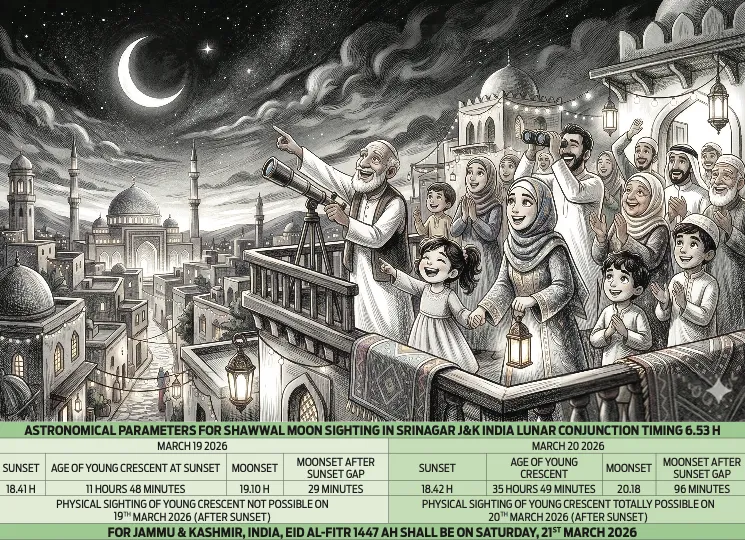
Applying these two critical conditions of Babylonian Prediction Criterion to the astronomical data for Srinagar City for the evening of March19, 2026, we conclude that the young crescent on that evening shall neither be sighted through naked eyes nor through simple optical aid, like binoculars, as the crescent is underaged at 11 hours, 48 Minutes as against the requisite of a minimum of 24 hours. Similarly, the crescent shall be available for a duration of 29 minutes only, as against mandatory presence of a minimum of 48 Minutes for a successful sighting.
Starting the process afresh on the evening of March20, 2026, we shall have an extremely favourable set up for crescent sighting (weather permitting), with the age of crescent close to 36 hours and availability over horizon for close to 100 minutes.
This establishes, theoretically, March 21 2026 as the first day of Shawwal 1447 AH and the day of Eid Al-Fitr, In Shaa Allah.
The Author is working as
Executive Engineer in JKPDD
| ASTRONOMICAL PARAMETERS FOR SHAWWAL MOON SIGHTING IN SRINAGAR J&K INDIA LUNAR CONJUNCTION TIMING 6.53 H | |||||||
| MARCH 19 2026 | MARCH 20 2026 | ||||||
| SUNSET | AGE OF YOUNG CRESCENT AT SUNSET | MOONSET | MOONSET AFTER SUNSET GAP |
SUNSET | AGE OF YOUNG
CRESCENT |
MOONSET | MOONSET AFTER SUNSET GAP |
| 18.41 H | 11 HOURS 48 MINUTES | 19.10 H | 29 MINUTES | 18.42 H | 35 HOURS 49 MINUTES | 20.18 | 96 MINUTES |
| PHYSICAL SIGHTING OF YOUNG CRESCENT NOT POSSIBLE ON
19TH MARCH 2026 (AFTER SUNSET) |
PHYSICAL SIGHTING OF YOUNG CRESCENT TOTALLY POSSIBLE ON
20TH MARCH 2026 (AFTER SUNSET) |
||||||
| FOR JAMMU & KASHMIR, INDIA, EID AL-FITR 1447 AH SHALL BE ON SATURDAY, 21ST MARCH 2026 | |||||||
The post And the Eid falls on…… appeared first on Greater Kashmir.