
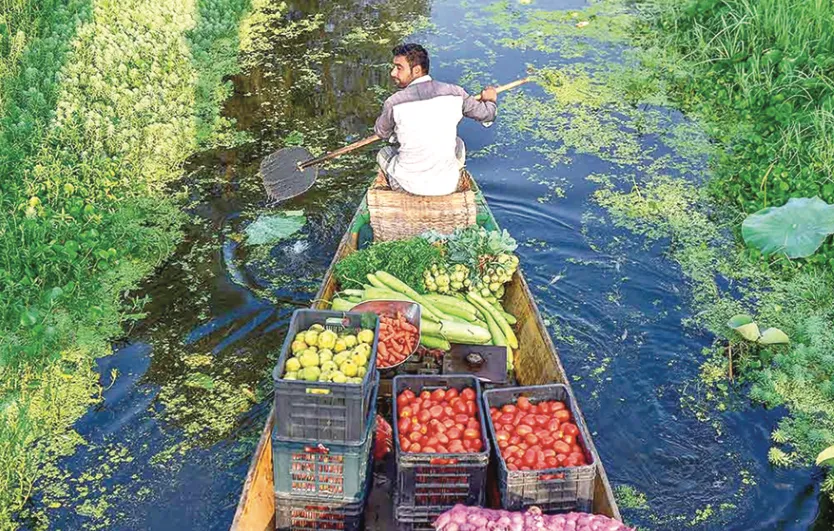
Srinagar, Feb 4: Long before sunrise, when Dal Lake lies cloaked in silence, narrow wooden boats begin to glide across its still waters. By 4 am, the lake has transformed into Sabzi Bazaar—India’s only floating vegetable market and a centuries-old lifeline for families living on the water.
Farmers row in from their floating gardens, locally known as radh, laden with freshly harvested produce—tomatoes, leafy greens, carrots, radishes, turnips, chestnuts and nadru (lotus stem), a staple of Kashmiri cuisine. The boats converge at Gudher, literally meaning “gathering place,” where trading continues till sunrise.
Between 4 am and 8 am, the quiet lake hums with activity. Vendors sell vegetables, flowers and cups of steaming kahwa, while buyers—mostly local traders and residents, with the occasional tourist—bargain across boats. In some cases, barter still replaces cash. Once the market disperses, unsold produce is taken to nearby street markets, and Dal Lake slips back into calm.
Among the vendors are children and teenagers from boat-dwelling families, many of whom help their parents before heading to school. Their participation reflects a way of life passed down through generations, surviving despite rapid urbanisation and shrinking livelihoods.
“I am 19 years old. I have been helping my family with this work for the past two years, and I love doing it because it is our family tradition. I want to continue it,” says Sajjad Ahmad, son of a vegetable trader.
Every evening, Sajjad accompanies his father to their floating farm to check which vegetables are ready for harvest. “Then early in the morning, around 5 am, we wake up and travel to the market in our boat filled with fresh produce. The market ends at sunrise—once the sunlight touches the lake, everything winds up,” he explains.
The vendors are both farmers and sellers, most of them residents of Dal Lake who cultivate vegetables on patches of land created within the lake itself.
“I am not ashamed of doing this work. I actually enjoy it,” Sajjad says. “The younger generation should not feel embarrassed about continuing family traditions. This is our identity.”
His father echoes the sentiment. “This floating garden is my ancestors’ prized possession. They formed it by collecting soil and organic waste from the lake. I am taking care of a family heirloom,” he says.
The floating market is believed to date back to the reign of Sultan Zain-ul-Abidin, the eighth ruler of Kashmir, and possibly earlier, to the Mughal era. Unlike many heritage spaces that have turned into tourist spectacles, the Dal Lake market continues to primarily serve local communities.
But its future is uncertain.
Despite snow and bone-chilling winters, young boys continue to shovel snow off their floating gardens to harvest vegetables. Yet environmental degradation is taking a toll. Dal Lake has been shrinking due to pollution and encroachment, and several families have been relocated. As a result, an increasing share of vegetables sold at the market now comes from nearby villages rather than the lake itself.
According to vendors, earnings fluctuate sharply. “Profits depend on the season and vegetable rates. During a good season, transactions worth a few lakhs take place in the morning market,” Sajjad says.
Still, many young people are opting out.
“The future looks grim,” says another vendor. “The younger generation no longer wants to continue the family business. They prefer technology and an easier way of life.”
Low income, physically demanding work, and environmental risks have made the floating market less attractive to youth, pushing many to seek more stable employment on land. Unless the lake is restored and livelihoods secured, the boats that gather before dawn may one day stop coming altogether.
By: Ifrah Shakeel