
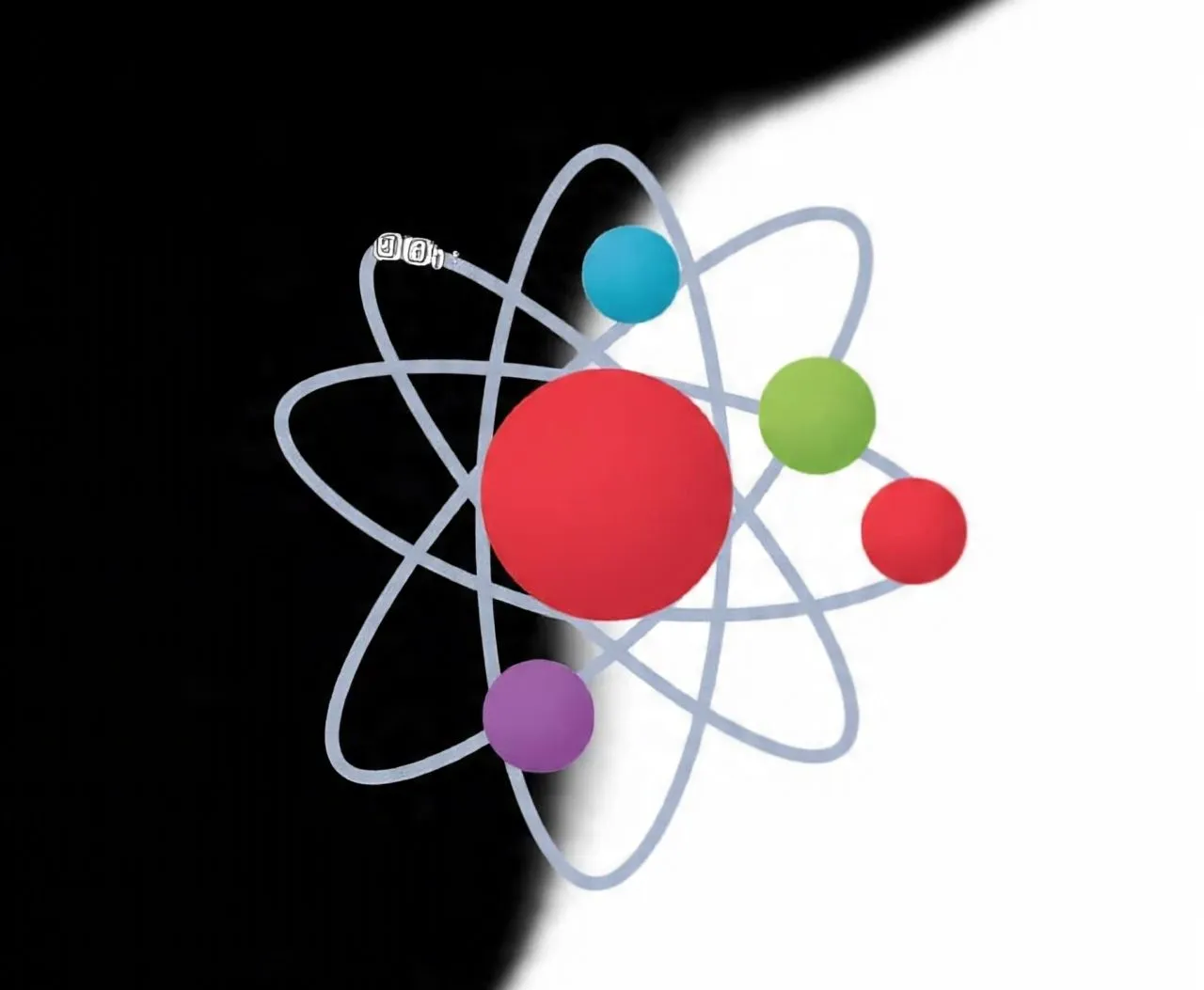
Most people first meet the atom in school. It is described as the smallest unit of matter. Everything around us, air, water, metal, our own bodies, is made of atoms. That idea feels complete. If you keep dividing matter into smaller and smaller pieces, you eventually reach atoms. That is usually where the explanation stops. For a long time, scientists also believed this was the end of the story.
The idea itself is very old. Democritus suggested that matter is made of tiny pieces that cannot be divided further. He imagined these pieces moving in empty space. He had no experiments to support this. It was a philosophical idea. Still, the basic thought, that matter is not continuous but made of small units, stayed alive.
In the early 1800s, John Dalton gave strong scientific support to this idea. He studied chemical reactions and noticed something important. Substances combine in fixed amounts. For example, water is always made from hydrogen and oxygen in the same ratio. Dalton explained this by saying that matter is made of separate atoms that join together in simple number patterns. His explanation worked very well. After that, atoms became part of real science, not just philosophy.
At first, atoms were thought to be solid and indivisible. But that did not last. In 1897, J. J. Thomson discovered the electron. This showed that atoms have smaller parts inside them. Later, Ernest Rutherford found that most of the mass of an atom is concentrated in a tiny central nucleus. The rest is mostly empty space. That was surprising. What seemed solid was mostly nothing.
Then Niels Bohr proposed that electrons move around the nucleus in specific energy levels. This helped explain why atoms give off light at certain exact colors. Later, quantum mechanics improved this picture. Electrons were no longer described as little balls moving in circles. Instead, they were described in terms of probability. We could not say exactly where an electron was, only the chance of finding it in a certain place.
Even with these changes, the atom remained central. Chemistry depended on it. Physics depended on it. Technology developed using atomic theory. The atom still seemed like the basic building block of matter, even if it had internal structure. The deeper change came in the twentieth century with the development of quantum field theory. The name sounds complicated, but the basic idea can be stated simply.
In this theory, what we usually call “particles” are not tiny solid objects. Instead, they are small disturbances in something more basic called a field. A field is something that exists everywhere in space. For example, temperature in a room can be described as a field because it has a value at every point. In modern physics, there are fields that fill all of space all the time.
According to this view, an electron is not a tiny hard sphere. It is a small vibration or disturbance in an electron field. A photon, a particle of light, is a disturbance in the electromagnetic field. These fields are always present. What we see as particles are brief, localized effects within them.
This changes how we think about atoms. An atom is no longer the most basic piece of matter. Instead, it is a stable combination of these field disturbances. For example, a hydrogen atom can be described as a proton and an electron interacting through the electromagnetic field. The stability of the atom comes from the rules that govern these fields.
So the atom is not the deepest layer of reality anymore. Beneath it, in modern theory, are fields. Does this mean atoms are not real? No. Atoms are very real in experiments. Scientists can move individual atoms on surfaces. Atomic clocks measure time using changes inside atoms. Chemistry works because atoms behave in regular and predictable ways. Nothing in modern theory makes atoms disappear. What has changed is their position in our understanding. They are not the final step. They are part of a deeper structure.
It is also important to say that science is not finished. Quantum field theory works extremely well in many areas. It predicts experimental results with great accuracy. But it does not yet fully explain gravity at the quantum level. There are also open questions about dark matter and dark energy. It is possible that future theories will change our picture again. May be what we know now “field” turns out something else, may be a “command” from God.
The history of the atom shows a clear pattern. What seems fundamental at one time may later turn out to be made of something deeper. The indivisible atom became divisible. The solid particle became mostly empty space. The particle itself became a vibration in a field. Still, the atom did not lose its importance. It simply moved to a different level in the hierarchy of ideas.
Today, we can think of reality as layered. At one level, there are molecules and materials. Below that level, there are atoms. Below atoms, there are smaller parts like electrons and quarks. And beneath those, according to current theory, there are fields.
Each level has its own usefulness. A chemist does not need to think about quantum fields when studying reactions. An engineer designing materials works at the atomic level. A particle physicist works at the level of fields. The choice depends on the problem. So what is the present status of the atom? It is still essential. It is still measurable. It still explains the structure of matter. But it is no longer the smallest possible unit. It is not the final answer to the question, What is everything made of?
Instead, the atom is a stable structure that emerges from deeper processes. It remains one of the most successful ideas in science, even though it is no longer considered fundamental. That is not a failure of the idea. It is a sign of progress. Science does not usually destroy old concepts. It places them inside wider frameworks. The atom once stood at the bottom of our picture of the world. Now it stands in the middle. And for the moment, that is where it remains.
Obeida Ashraf is a teacher by profession
The post Evolution of an ATOM? appeared first on Greater Kashmir.