
Blessed with glacier-fed and oxygen rich streams, Jammu and Kashmir has immense potential to undertake trout breeding on a national scale. It is great to know that the J & K Government has been successful in making the Union Territory the top trout producer among the country’s cold-water regions.
Official figures state that trout output increased from 1663 tonnes in 2021-22 to a record 2650 tonnes in 2024-25. Besides private sector trout units increased from 936 to 1649, hatcheries from one to nine, trout feed mills from zero to six by 2024, Recirculating Aquaculture Systems (RAS) units from two to nine; and biofloc units from 10 to 59 respectively. Under Holistic Agriculture Development Programme (HADP), launched in 2022, Rs. 233 crore was allocated for fisheries to incentivise entrepreneurship, establish hatcheries, trout farming, and value-added ventures. And this has paid dividends by increasing fish production.
Trout rearing has come a long way in J&K. The process started in 1899 when the first batch of trout ova of 10,000 eggs was imported from the United Kingdom by the Duke of Bedford but the ova could not survive. On December 19, 1900, the second shipment of trout ova arrived in Kashmir from Scotland on December 19, 1900. Out of 1800 fry, 1000 were transferred to Panzagam Dachigam and rest were reared in premises of a private carpet factory at Baghi Dilawar Khan. Subsequently Mother Trout Fish Farming Project was set up in Kokernag area in south Kashmir under European Union Assistance. Then a Trout hatchery was set up at Laribal. Gradually several trout rearing units and hatcheries came up in various areas of Kashmir. Subsequently Rainbow and Brown trout populations increased over the decades in Kashmir streams.
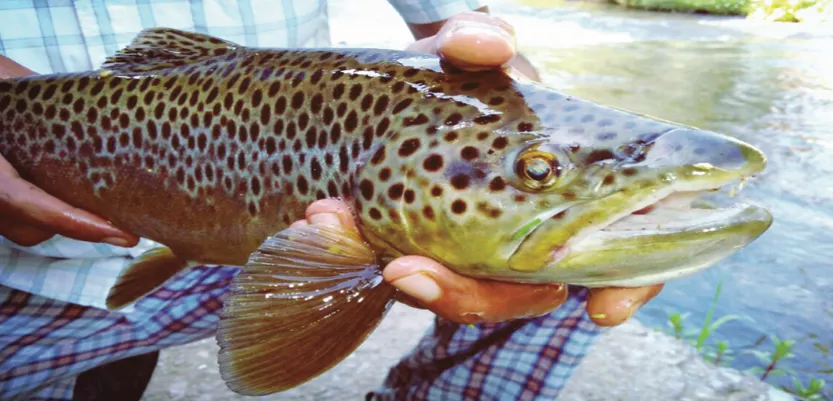
Gushing streams including Lidder, Sukhnag, Wangath, Hirpora, Gurez, Bringi, Kishanganga, Sindh, Erin, Ferozpora, Tangmarg, Kokernag and Aharbal were favourite fishing spots of tourists especially foreigners. Owing to the trout rich stream, Kashmir earned the sobriquet of “Anglers’ Paradise”. Rainbow and brown trout of Kashmir are in high demand. Trout reared in Kashmir streams is said to be less spongy, has fewer scales, tender bones and are mostly disease free than its counterparts in other states. However, siltation and pollution in streams took a massive toll on trout. Illegal riverbed mining with use of heavy machines in various streams destroyed habitat of trout and other fish species. As pollution was not enough, use of chemicals to kill trout is rampant. The blatant use of pesticides, insecticides and other chemicals in orchards close to streams is slowly leading to decline in trout population. Construction of hydroelectric projects and dams have already knelt death blow to trout.
Though the Fisheries Department has been undertaking various measures to increase the productivity of trout, strict action is required to protect fish habitats. In December last year, more than 3 lakh eyed brown trout ova imported from Denmark were released into more than 40 streams and 12 lakes across Kashmir after 125 years. The objective is to restore the species in the valley’s streams. What makes Brown trout important is that it grows largely outside culture and thrives on natural feed. Brown trout are known for their natural life cycle. These have the ability to mature independently of human intervention, often migrating before spawning and surviving in diverse freshwater environments. While the Rainbow trout is typically cultured in raceways, ponds, or cages under controlled conditions. Prolonged breeding of Brown trout on artificial feed or pellet-based nutrition lead to genetic depression, poor growth, and high mortality. Rainbow trout has become the backbone of Kashmir’s trout farming industry supported by public and private hatcheries and government schemes like the Pradhan Mantri Matsya Sampada Yojana (PMMSY).
To further strengthen aquaculture, Government of India has sanctioned Rs 100 crore Integrated Aqua Park Project to be established in south Kashmir’s Anantnag district. This was announced by the Union Minister Fisheries, Animal Husbandry and Dairying (FAH&D) and Panchayati Raj, Rajiv Ranjan Singh during the national conference on Cold Water Fisheries organised by Department of Fisheries, Government of India, at the Sher‑e‑Kashmir International Conference Centre (SKICC), Srinagar. The Aqua Park Project will facilitate enhancing trout productivity and help to foray into export markets where these fish species hold massive demand.
Lieutenant Governor Manoj Sinha maintains that fish production and related infrastructure had seen substantial growth since 2020. LG states that J&K holds promise as a national model for integrated fisheries development. The value-chain approach will generate jobs, cut post-harvest losses, and boost fish farmers’ incomes.“Our strategic initiatives have positioned J&K as the leader in trout production across all cold-water states. Under the guidance of Prime Minister Narendra Modi, our focused efforts have made J&K the top trout producer among India’s cold-water states,” the LG said.
Chief Minister Omar Abdullah has been emphasising the need to adopt improved scientific techniques and develop modern infrastructure and do value addition to enhance cold water fisheries production in J&K while ensuring sustainability and livelihood security for fish farmers. CM Omar cited an example of a youth entrepreneur from Hyderabad producing 200 metric tons of trout through advanced techniques in tropical climate stating how technology can overcome geographical limitations.
Though there is a strong political will to support development of fisheries in J&K, the same efforts are needed for conservation of streams and water bodies which form the habitat of fish. Amid climate change and rising pollution levels, there is a need to strike a balance between development and environment. We need to go for sustainable development to maintain ecological balance.
Author is Executive Editor,
Greater Kashmir