
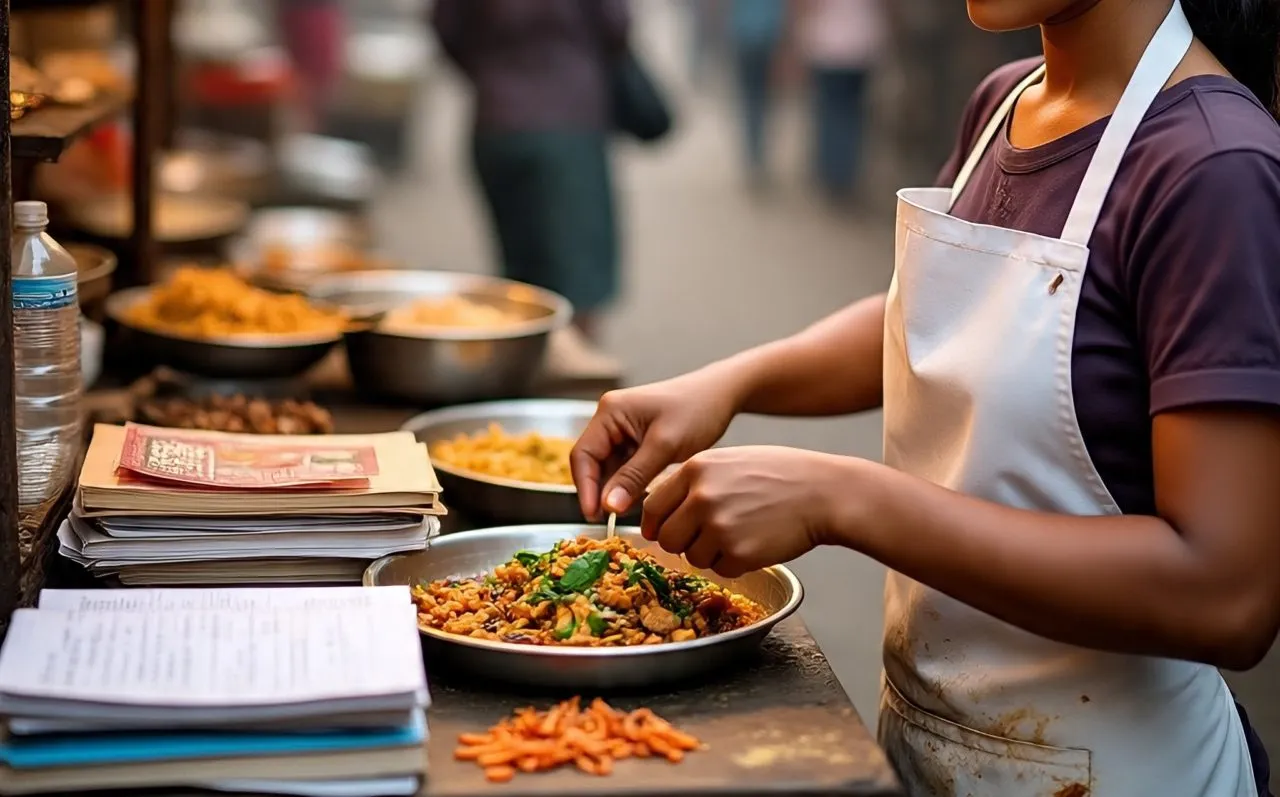
In a society that has perfected the art of romanticising suffering while actively sabotaging dignity, the sight of a young woman selling omelettes and momos on the streets of Batamaloo is not merely an anecdote – it is an indictment. It unsettles because it violates the carefully constructed moral theatre of Kashmir, where education is fetishised but labour is despised, where ambition is applauded in theory but punished in practice, and where dignity is spoken of endlessly yet denied to those who earn it with their hands. The young woman, a civil services aspirant, by aspiration, and a street vendor by survival, does not merely sell food; she exposes the rot in our collective conscience. Her act is radical not because it is extraordinary, but because it is honest.
We are conditioned to believe that aspiration and labour must occupy separate moral universes. The civil services aspirant is expected to inhabit libraries, coaching centres, and drawing rooms filled with borrowed optimism. The street vendor, in contrast, is relegated to the margins- useful, tolerated, but never respected. By standing at a roadside stall with a pan and a ladle while simultaneously preparing for one of the most competitive examinations in the State, this woman collapses that artificial divide. She refuses to perform poverty the way society demands it be performed- silently, submissively, and with shame. In doing so, she disrupts a deeply entrenched hierarchy that equates worth with whitened collars and unemployment with “preparation.”
What makes her story particularly unsettling is not the hardship she faces, but the clarity with which she articulates it. When she says it is better to earn than to beg, she is not delivering a slogan; she is holding up a mirror to a society that has normalised intellectual begging while vilifying physical work. Kashmir today is full of able-bodied men waiting- waiting for government notifications, waiting for references, waiting for miracles- while scorning any work that does not come with a designation or an air-conditioned room. The tragedy is not unemployment alone; it is the cultural degradation that has made work itself a source of humiliation. In this moral vacuum, a young woman choosing self-reliance over dependence becomes an act of resistance.
Her experience of seeking help and being treated with suspicion, condescension, or outright dismissal is not incidental- it is structural. Ours is a society that claims to revere women yet recoils when they assert agency outside approved scripts. A woman asking for help to stand on her own feet is treated as an inconvenience; a woman enduring suffering quietly is elevated into a symbol. This hypocrisy is not accidental. It allows society to retain its patriarchal comfort while outsourcing compassion to rhetoric. When she narrates how doors were closed, how people moralised instead of assisting, how empathy was rationed, she exposes a deeper truth: that we prefer helplessness over independence because helplessness does not challenge power.
There is something deep in the fact that her work involves food- omelettes, momos, the everyday sustenance of ordinary people. She offers a service, demands nothing but a fair price, and insists on her right to exist without apology. In a region where economic narratives are often drowned under the weight of victimhood, her choice asserts a different vocabulary- one of agency rather than grievance. She does not deny structural injustice, but she refuses to be immobilised by it. That refusal unsettles those who have built entire identities around waiting to be rescued.
The most uncomfortable question her presence raises is directed at men. In a society where masculinity is loudly proclaimed but quietly hollowed out, why is it that a woman must demonstrate what self-respect looks like? Why has honest labour become feminised and thus deemed unworthy by men who otherwise speak incessantly of honour? The flight of male labour from such work is not due to lack of opportunity alone; it is due to a warped sense of entitlement. Too many men would rather be unemployed with pride than employed with humility. Her stall stands as a silent rebuke to that cowardice.
Education, we are told, is meant to liberate. But in Kashmir, education has increasingly become a waiting room- producing degrees without direction, aspirations without anchors. The civil services dream, noble as it may be, has become a convenient alibi for prolonged economic dependency. Preparation stretches into years, sometimes decades, with families absorbing the cost and society offering moral cover. This woman disrupts that arrangement. She prepares without surrendering her present to an abstract future. She refuses the false binary between ambition and survival. That refusal exposes how deeply unserious we have become about both.
Her story also punctures the myth that dignity is bestowed from above. Dignity is not something granted by the state, by institutions, or by benevolent elites. It is forged in the act of standing upright when circumstances demand compromise. The dignity in her work does not come from public applause or viral videos; it comes from her refusal to internalise shame. That is what terrifies society the most- because shame has long been its primary instrument of control.
Kashmir’s public discourse is saturated with lamentation. We speak endlessly of lost opportunities, broken systems, and betrayed generations. All of that is true. But lamentation has also become a refuge from responsibility. Her presence forces a reckoning: what do we do when someone chooses action over articulation? Do we support her materially, or do we merely circulate her story as emotional content before returning to our inertia? Too often, inspiration is consumed the way entertainment is- briefly, passively, and without consequence.
This is not a fairy tale of individual triumph over structural injustice. To frame it as such would be dishonest and cruel. She should not have to do this. No young woman with academic ambition should be forced into precarity to survive. But acknowledging that truth does not diminish the significance of her choice; it amplifies it. She does not romanticise struggle. She endures it with eyes open, without theatrics, without self-pity. That sobriety is what lends her story its moral force.
What she ultimately offers is not hope in the abstract, but a challenge – particularly to a society that has learned to speak eloquently about dignity while systematically undermining it. She asks, without shouting, whether we are willing to respect labour when it is performed by those we otherwise patronise. Whether we can accept that self-worth does not require institutional validation. Whether we can finally abandon the lie that some forms of work are beneath us.
Her stall in Batamaloo is not just a place of livelihood; it is a site of confrontation. It confronts our class prejudices, our gender anxieties, our moral laziness. It confronts a generation that wants outcomes without process, status without effort, and dignity without labour. And in that confrontation, she does not ask for sympathy. She demands recognition- not as a symbol, but as a citizen who has chosen to live without begging, in a society that has made begging respectable and work disgraceful.
The real danger is not that a young woman has been pushed to sell food on the streets while preparing for civil services; the real danger is that society finds this acceptable as long as it remains an exception, a spectacle, a momentary moral high. Kashmir has mastered the art of turning individual resilience into collective alibis. We celebrate stories like hers not to change conditions, but to absolve ourselves of the responsibility to challenge them. Her struggle becomes inspirational content, safely detached from the structural failures that necessitated it in the first place. This is where dignity is again betrayed- this time not through disdain, but through hollow applause.
The reaction to her story exposes how deeply performative our empathy has become. People share her video, praise her courage, and then proceed to discourage their own daughters and sons from similar work. Compliments flow easily; support does not. Very few ask whether she has access to stable infrastructure, legal protection, healthcare, or academic support. Very few interrogate why a civil services aspirant must rely on street vending to survive in the first place. Sympathy, when it does not translate into solidarity, becomes another form of exploitation. Her pain is consumed, not confronted.
There is also a deeper class anxiety at play. Her visibility unsettles the middle-class moral order, which is built on a fragile illusion of upward mobility. For many families, the promise of education is not learning but escape- escape from manual labour, from the street, from precarity. When a woman who embodies academic ambition chooses visible labour, she threatens that illusion. She forces society to confront an uncomfortable truth: that education does not guarantee security, and that dignity cannot be outsourced to certificates. That is why her work is quietly policed through pity, unsolicited advice, and moral judgement. She is told to “focus only on studies,” as if survival were a distraction rather than a necessity.
Her gender amplifies this discomfort. A man doing the same work might be pitied or ignored; a woman doing it is scrutinised. Her body, her presence, her choices become public property. This is how patriarchy adapts- it does not always prohibit; it disciplines. It allows women to work only within carefully sanctioned boundaries, and when those boundaries are crossed, it deploys shame as correction. That she persists anyway is what gives her story its enduring force. She refuses to ask for permission to survive.
But admiration alone is not enough. If her story is to mean anything beyond momentary inspiration, it must provoke a collective rethinking of how we value work. Kashmir cannot afford its current moral economy, where unemployment is normalised and labour is stratified by perceived prestige. A society that teaches its youth to despise honest work while waiting endlessly for scarce opportunities is not merely failing them- it is sabotaging its own future. Her insistence on earning rather than begging cuts through this malaise with brutal clarity. Begging, in this context, is not just literal- it is metaphorical. It is the dependence on connections, favours, political patrons, and moral charity. It is the quiet surrender of agency in exchange for temporary relief. By rejecting that path, she exposes how deeply embedded it has become in our social fabric. Her labour is not just a means of income; it is a declaration of independence in a society that has grown comfortable with dependence.
There is also an uncomfortable lesson here for political discourse. Much of Kashmir’s rhetoric revolves around rights, dignity, and justice- and rightly so. But rights without a culture of work, dignity without economic agency, and justice without self-respect become abstractions. Her life demonstrates that dignity is not postponed until conditions improve; it is practised despite conditions. This does not absolve the state or institutions of responsibility, but it does challenge the fatalism that has paralysed collective action.
What she ultimately represents is not a solution, but a warning. A warning that if society continues to vilify labour, romanticise unemployment, and outsource responsibility to narratives of suffering, it will produce more despair, not less. A warning that gender equality cannot be proclaimed while women are punished for economic independence. A warning that education divorced from livelihood becomes cruelty disguised as hope.
Her stall in Batamaloo is temporary; her lesson should not be. The real test is not whether her story goes viral, but whether it changes conversations in homes, classrooms, and public spaces. Whether parents stop discouraging honest work. Whether young men stop equating dignity with inactivity. Whether society finally recognises that no work done with integrity is beneath anyone.
Until then, her quiet defiance will continue to stand in contrast to our loud hypocrisy. She will keep working, not because she wants to be celebrated, but because survival leaves no room for illusions. And in doing so, she will continue to expose a society that speaks endlessly of dignity, yet trembles when confronted with someone who actually lives it.
Zahid Sultan, Kashmir based Independent Researcher