
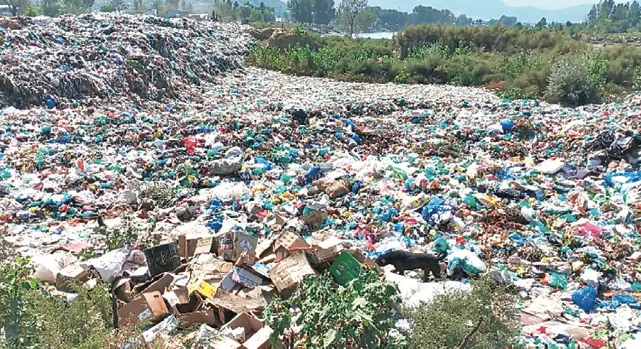
Jammu, Apr 5: In the absence of any policy, action plan or strategy for implementation of “Reduce, Reuse and Recycle’ (3 Rs), a staggering 61-69 percent of solid waste was dumped at landfill or dumping sites during 2017-22, carrying the risk of harmful impact on the environment.
The startling revelation has been made in the compliance audit on “Solid Waste Management in Urban Local Bodies (ULBs)” of the Union Territory.
Solid waste processing facilities such as ‘Waste to energy plant, Leachate treatment plant, city compost plant, waste disposer machine and bailing machine, as per composite audit report of the Comptroller and Auditor General of India for the period ended March 2022, remained non-functional in various ULBs of the UT.
The Subject Specific Compliance Audit (SSCA) on Solid Waste Management (SWM) in ULBs covered the period 2017-18 to 2021-22. It entailed examination (October 2022 to March 2023) of the records relating to SWM in the Administrative Department i.e., Housing and Urban Development Department (H&UDD), Mission Director, Swachh Bharat Mission (SBM), Directors of Urban Local Bodies (ULBs), Kashmir and Jammu and 15 ULBs out of 76 ULBs selected on the basis of probability proportional to size without replacement method.
The findings of this audit were shocking.
During 2017-22, 91 per cent to 99 per cent of waste generated in the ULBs was being collected, however only 31 per cent to 39 per cent of collected waste was being treated in the UT.
In 17 ULBs, segregation of waste at source or house was not being carried out during 2017-22. In 11 ULBs, coverage of door-to-door collection of solid waste from households and commercial establishments was partial. Three ULBs had not carried out door-to-door collection of waste.
Although Jammu Municipal Corporation (JMC) and Srinagar Municipal Corporation (SMC) claimed 100 per cent door-to-door collection of waste during 2020-22, there was a shortfall in collection of user charges.
Besides, two ULBs (MC Hiranagar und MC Rajouri) were dumping solid waste unauthorisedly and unscientifically.
No processing or treatment facilities were in place at the waste dumping sites of 15 ULBs, as such the waste was being dumped without modifying its physical chemical or biological characteristics resulting in potential danger to the environment.
Flagging another critical point, the audit pointed out that J&K Pollution Control Committee (JKPCC) had not conducted any air quality assessment in respect of landfills or dumpsites and had not regularly assessed the risk of contamination of ground water near landfill or dumping sites.
In 17 sampled ULBs, shortage of Manpower ranged between 9.25 per cent (Bijbehara) and 75 per cent (Langate).
With regard to Solid Waste Management (SWM) Policy, the CAG audit mentioned that the J&K government had prepared it (SWM strategy policy) in 2017 but it had not been finalised or notified as of February 2025. As such implementation of 3 Rs (Reduce, Reuse and Recycle) in the UT was deficient in policy direction.
In the just concluded budget session of J&K Legislative Assembly, the government, itself, admitted that solid waste management emerged as a major challenge across UT due to the increasing volume of waste generated daily.
It said that the Operations and Maintenance (O&M) policy for SBM(G) and Solid and Liquid Waste Management assets was in the final stages of formulation to ensure systematic upkeep, functionality and long-term sustainability.
Notably in March, 2026, J&K government accorded approval for the development of Integrated Solid Waste Management (ISWM) facilities in the Anantnag-Mattan-Bijbehara cluster, Kathua-Hiranagar-Parole-Lakhanpur cluster and Jammu zone at a total outlay of Rs 1,162.40 Cr. The initiative, as per officials, will enable scientific and efficient waste management, significantly enhancing urban sanitation and environmental sustainability across these regions.
Meanwhile, the Solid Waste Management Rules, 2026 notified by the Ministry of Environment, Forest and Climate Change too came into effect from April 1, 2026 across the country, into J&K.
These rules – which are based on a segregation driven, accountability-based and circular economy-oriented framework – make four-stream segregation (at source, wet waste, dry waste and sanitary waste) mandatory.
Question, however, remains – Will it change the scenario in J&K vis-vis mammoth challenge of solid waste?